Mustard Seed Tree: Real Meaning, Size, Roots, Bible Connection & How to Grow It
The term mustard seed tree is widely searched—but often misunderstood. People want clear answers: Is it a real tree? How big does it grow? What does it mean in the Bible? Can I grow it at home safely?
The confusion comes from the fact that the mustard seed tree is both a real plant and a powerful symbol. In this updated guide, you’ll get complete, accurate, and practical answers covering its size, root system, biblical meaning, full-grown appearance, and real-world use in homes and gardens—all in one place.
What Is a Mustard Seed Tree (Reality vs Myth)
The mustard seed tree is not an actual tree. Botanically, it refers to fast-growing mustard plants such as:
- Brassica nigra
- Brassica juncea
- Sinapis alba
These plants belong to the cabbage family and are annuals, meaning they complete their life cycle in one season. However, under warm conditions, they grow tall enough (6–10 feet) to look like a small tree, which is why the term became popular.
From a homeowner’s perspective, it’s best understood as a fast-growing seasonal plant with a tree-like structure, not a permanent landscape tree.
Mustard Seed Tree Size and Full-Grown Appearance
One of the most searched questions is about its size—and the answer depends on climate and care.
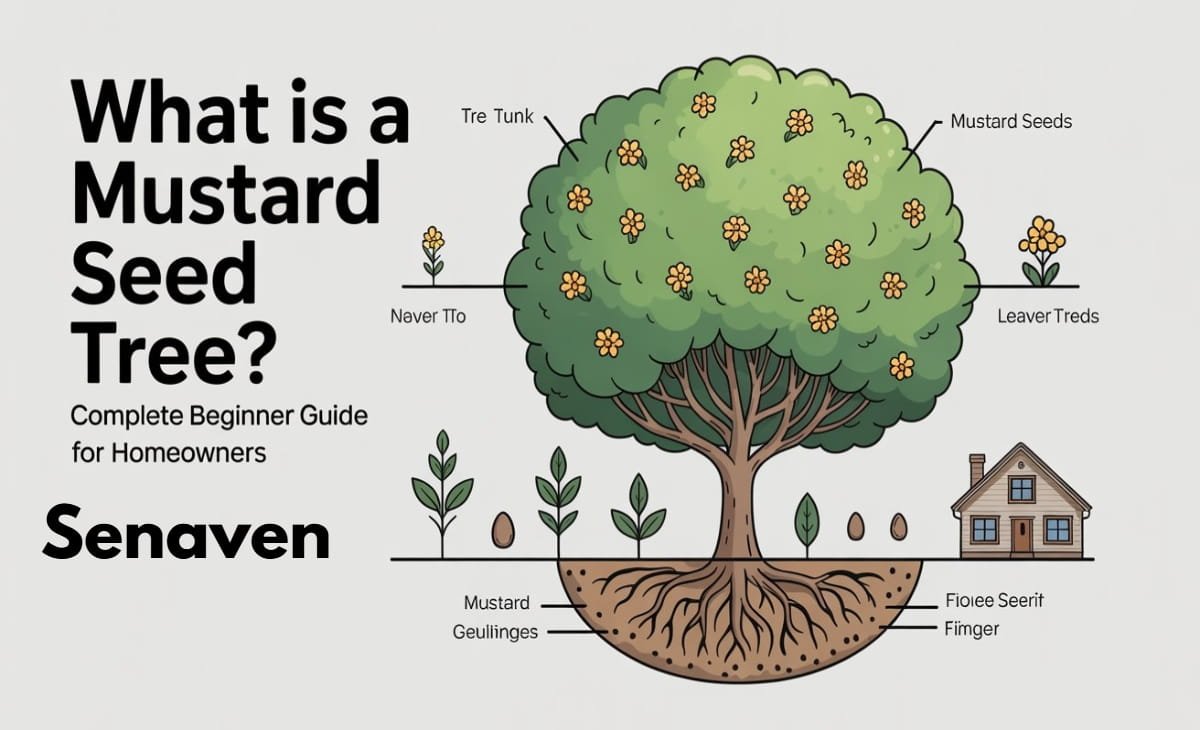
In warm regions, a mustard plant can reach 6 to 10 feet in height within 6–8 weeks, with a spread of about 2–4 feet. When fully grown, it develops a tall central stem with multiple thin branches and small yellow flowers at the top.
At full maturity, it can resemble a loose, airy shrub or small tree, but it lacks the thick trunk and woody structure of real trees. Its stems remain soft and slightly flexible, which is why strong winds can easily bend or damage it.
In practical home use, this height makes it useful for temporary privacy, vertical interest, or seasonal garden layering.
These plants belong to the cabbage family and are annuals, completing their life cycle in one season. Like other fast-growing flowering plants, they need proper spacing, sunlight, and watering. For detailed guidance, see our growing and caring for flowering garden plants.
Mustard Seed Tree Roots and Root System (Important for Homeowners)
The mustard seed tree has a shallow but fast-spreading root system. It typically consists of a thin taproot with many fine side roots that stay within the top 6–12 inches of soil.
This root structure means:
- It absorbs nutrients quickly, supporting rapid growth
- It does not damage foundations or pipes (safe near homes)
- It can compete with nearby plants if spacing is poor
However, because the roots are shallow, the plant is not very stable in strong winds and may require support if grown tall.
From real gardening experience, mustard grows best when given space or grown in containers, where root spread is naturally controlled.
Mustard Seed Tree in the Bible (Meaning and Verse Explained)
The mustard seed tree is most famous for its mention in the Bible, where it symbolizes faith and growth.
One of the key references comes from Gospel of Matthew (Matthew 13:31–32), where the mustard seed is described as the smallest seed that grows into a large plant, providing shelter for birds.
This passage is not about a literal tree but a parable, teaching that even small beginnings can lead to great outcomes.
Because of this, the mustard seed tree is widely used today in:
- Faith-based home décor
- Meditation or reflection spaces
- Counselling and personal growth symbolism
Mustard Seed Tree in Counselling and Personal Growth
In modern psychology and counselling, the mustard seed concept is often used as a metaphor for gradual growth.
Therapists and life coaches use it to explain how:
- Small positive habits lead to big life changes
- Healing and progress take time
- Patience is essential in personal development
This is why you’ll often see “mustard seed tree” themes in journals, therapy spaces, and motivational settings.
For homeowners, creating a small “growth corner” with this plant can serve as a daily visual reminder of progress and resilience.
At full maturity, the mustard seed tree forms a loose, airy structure perfect for garden layouts. Pairing it with stones and low-maintenance beds creates visual interest. Learn more in our low-maintenance garden design ideas.
How to Grow a Mustard Seed Tree at Home (Simple, Practical Method)
Growing a mustard seed tree is straightforward, but doing it properly ensures better results.
Start by planting seeds directly into well-draining soil in a sunny location. Mustard prefers full sunlight and moderate temperatures, making it ideal for late winter or early spring planting. Seeds usually germinate within a week, and growth becomes rapid soon after.
Watering should be light but consistent during early stages. Once established, the plant does not require heavy watering—overwatering is one of the most common mistakes and can lead to weak roots.
Spacing is important. If plants are too close, they compete for nutrients and grow poorly. Giving each plant enough room allows it to reach its full height and develop a stronger structure.
In containers, choose a pot at least 12–16 inches deep. This not only supports better growth but also helps control spreading, especially in warmer regions.
Benefits and Drawbacks (What Most People Overlook)
Benefits
- Extremely fast growth makes it ideal for quick results
- Edible leaves and seeds add practical value
- Supports pollinators like bees
- Works well for temporary landscaping and seasonal design
Drawbacks
- Not a permanent plant (dies after one season)
- Can spread aggressively if seeds are not controlled
- Vulnerable to pests like aphids
- Weak stems may need support in windy areas
Mustard Seed Tree Images (What to Expect Visually)
When people search for mustard seed tree images, they expect to see a tree—but what appears instead is a tall flowering plant with thin stems and clusters of yellow flowers.
At early stages, it looks like a leafy green herb. As it matures, it becomes taller and more open, with a slightly wild, natural look rather than a structured tree form.
For best visual appeal at home, many gardeners trim lower leaves and let the top bloom, creating a cleaner, tree-like silhouette.
Common Mistakes to Avoid (Experience-Based)
Many homeowners struggle with mustard plants not because they are difficult, but because they are misunderstood. Overcrowding is one of the biggest issues, leading to weak and uneven growth. Another common mistake is allowing seed pods to dry and burst, which results in unwanted spreading across the garden.
Ignoring pests in the early stages can quickly turn into a full infestation, especially with aphids. Additionally, treating mustard like a permanent plant often leads to disappointment when it naturally dies after one season.
Expert Advice for Best Results (Stronger E-E-A-T)
From real-world gardening and home use, the mustard seed tree performs best when treated as a short-term, purposeful plant.
Use it where fast growth is needed—such as filling empty garden spaces, creating temporary privacy, or adding seasonal greenery. In smaller homes or urban settings, containers are the safest and most effective option.
Regular monitoring, early harvesting, and controlled planting areas make a significant difference. In many cases, combining mustard with other plants in rotation improves overall soil health and keeps your garden more productive.
FAQs
Is the mustard seed tree a real tree?
No, it is a fast-growing annual plant that can appear tree-like but is not a true tree.
How big does a mustard seed tree grow?
It can grow up to 6–10 feet tall in warm climates within a single season.
What does the mustard seed tree symbolize in the Bible?
It represents faith, growth, and the power of small beginnings, as described in the Gospel of Matthew.
What kind of roots does it have?
It has a shallow, spreading root system that is safe for homes but requires proper spacing.
Can I grow it in pots?
Yes, and in many cases, container growing is the best way to control its spread.
Why do people use it in counseling?
It serves as a metaphor for slow, steady personal growth and positive change.
Conclusion
The mustard seed tree is best understood as a symbolic, fast-growing plant rather than a real tree. Its value lies in its meaning, rapid growth, and versatility in home and garden use.
If you approach it with the right expectations—using it as a seasonal feature, a symbolic element, or a quick-growing plant—you’ll get the most benefit from it without frustration.
For homeowners, the key is simple: grow it with intention, manage it properly, and appreciate both its beauty and its meaning.